
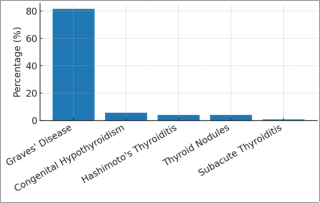
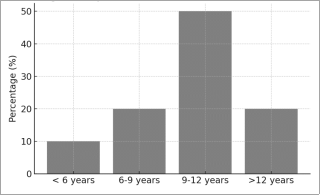
Introduction: The incidence of thyroid disorders in the pediatric population in Senegal is poorly known. The aim of our study was to contribute to a better understanding of the characteristics of these conditions in our setting. Methods: We conducted a descriptive cross-sectional study over a 30-month period. All patients aged 0 to 17 years followed for thyroid disorders were included. Data were collected using a survey form, entered in Microsoft Excel 2019, and analyzed with EPI Info version 7.1. Results: We collected data on 125 patients. Thyroid dysfunctions accounted for 62.8% of patients followed for endocrine disorders (excluding diabetes). The majority were female (68.8%) with a mean age at diagnosis of 8.9 years. Graves' disease was the most common diagnosis (81.6%) with a female predominance (67.6%). A neonatal form was observed in 4%. The mean age at diagnosis was 9.88 years. Goiter was the most frequent sign (89.1%). TSH receptor antibodies (TRAb) were positive in most patients (96.3%). Congenital hypothyroidism had a prevalence of 5.6%, with a mean age at diagnosis of 1.82 years. Three-quarters (75%) of patients had psychomotor developmental delay. Umbilical hernia was the most frequent sign (57.14%) in congenital hypothyroidism. Levothyroxine was used at an average dose of 6.9 µg/kg/day. Persistent hypothyroidism was found in 80% of cases. Other thyroid conditions included Hashimoto’s thyroiditis (4%), thyroid nodules (4%), and one case of subacute thyroiditis. Conclusion: Graves' disease was the most common diagnosis. These findings underscore the importance of early diagnosis and structured follow-up to prevent long-term complications.
| Published in | American Journal of Pediatrics (Volume 11, Issue 4) |
| DOI | 10.11648/j.ajp.20251104.18 |
| Page(s) | 253-257 |
| Creative Commons |
This is an Open Access article, distributed under the terms of the Creative Commons Attribution 4.0 International License (http://creativecommons.org/licenses/by/4.0/), which permits unrestricted use, distribution and reproduction in any medium or format, provided the original work is properly cited. |
| Copyright |
Copyright © The Author(s), 2025. Published by Science Publishing Group |
Thyroid, Children, Senegal
Parameters | Number (%) |
|---|---|
Gender (N = 125) | |
- Girls | 86 (68.8%) |
- Boys | 39 (31.2%) |
School attendance (n = 107) | |
- Attending school | 89 (83.18%) |
- Not attending school | 18 (16.82%) |
Geographic origin (n = 54) | |
- Urban | 32 (59.26%) |
- Rural | 22 (40.74%) |
Socioeconomic level (n = 124) | |
- High | 18 (14.52%) |
- Medium | 66 (52.2%) |
- Low | 40 (32.26%) |
Parental consanguinity (n = 124) | |
- Absent | 97 (78.23%) |
- First-degree | 6 (4.83%) |
- Second-degree | 21 (16.94%) |
Family history of thyroid dysfunction (n = 123) | |
- Present | 30 (24.39%) |
- Absent | 93 (75.61%) |
TSH | Thyroid-Stimulating Hormone |
TRAB | TSH Receptor Antibodies |
T4 | Serum Tetraidothyronine |
T3 | Serum Triiodothyronine |
| [1] | Wemeau J-L. Thyroid Deseases. Elsevier Health Sciences; 2022. |
| [2] | Leger J, Larroque B, Norton J. Influence of the severity of congenital hypothyroidism and adequacy of treatment on school achievement at 8 years of age: a prospective study of 82 children. J Clin Endocrinol Metab. 2001; 86(2): 561–7.. |
| [3] | Ryndak-Swiercz A. Ontogenesis, anatomy, histology and physiology of the thyroid gland. In: Thyroid Deseases,: Elsevier; 2010. p. 3-11. |
| [4] | El Ghissassi N, Daoudi A, Gaouzi A. Graves’ disease in children: clinical, evolutionary, and therapeutic aspects. Ann Endocrinol. 2012; 73: 306-35. |
| [5] | Folope V, Kuhn J. Severe adverse effects of non-substitutive medical treatments for endocrine and metabolic disorders: identification and practical management. Metabolism Hormones, Diabetes and Nutrition. 2005; 9: 143. |
| [6] | Mariko M, Traore B, Sow DS, et al. [Dysthyroidism in children and adolescents at the Mali hospital]. Mali Med. 2020; 35(1): 56-61. |
| [7] | Bhadada S, Bhansali A, Velayutham P, et al. Juvenile hyperthyroidism: an experience. Indian Pediatr. 2006; 43(4): 301-7. |
| [8] | Abodo J, Kelie E, Dago PK, et al. Profile of thyroid pathologies in sub-Saharan Africa: about 503 cases. Ann Endocrinol, 2016: Elsevier. |
| [9] | Boiko J, Leger J, Raux-Demay MC, et al. Graves’ disease in children: clinical and evolutionary features. Arch Pediatr. 1998; 5(7): 722–30. |
| [10] | Diagne N, Faye A, Ndao AC, et al. [Epidemiological, clinical, therapeutic and evolutive aspects of Basedow-Graves disease in the Depatment of Internal Medicine at CHU Aristide Le Dantec, Dakar (Senegal)]. Pan Afr Med J. 2016; 25: 6. |
| [11] | Toublanc J. Thyroid diseases in children (hypothyroidism, hyperthyroidism, and cancer). EMC–Pediatrics. 2007; 4–105. |
| [12] | Kaguelidou F, Alberti C, Castanet M, et al. Predictors of autoimmune hyperthyroidism relapse in children after discontinuation of antithyroid drug treatment. J Clin Endocrinol Metab. 2008; 93(10): 3817-26. |
| [13] | Carranza D, Van Vliet G, Polak M. Hyperthyroidism and hypothyroidism in neonates and children. EMC–Endocrinology–Nutrition. 2006; 3(3): 1. |
| [14] | Petignot S, Nyamugabo Munyere Nkana K, Valdes Socin Hg, et al. Neonatal hyperthyroidism: clinical features and therapeutic management. Rev Med Liège. 2013; 68(10). |
| [15] | Niang B, Fall AL, Ba ID, et al. Congenital hypothyroidism in Dakar: about 28 cases. Pan Afr Med J. 2016; 25: 46. |
| [16] | Bouree P, Ouedraogo S, Tapsoba T. Contribution of ultrasound to the diagnosis of thyroid diseases in Burkina Faso: about 54 cases. Medecine d’Afrique Noire. 2015. |
| [17] | Selva KA, Mandel SH, Rien L, et al. Initial treatment dose of L-thyroxine in congenital hypothyroidism. J Pediatr. 2002; 141(6): 786-92. |
| [18] | Bouferoua F, Ladjouz A, Zeroual Z, et al. Thyroiditis in children: growth and puberty. Ann Endocrinol (Paris). 2015; 76(4): 446–7. |
| [19] | Oerbeck B, Sundet K, Kase BF, et al. Congenital hypothyroidism: influence of disease severity and L-thyroxine treatment on intellectual, motor, and school-associated outcomes in young adults. Pediatrics. 2003; 112(4): 923-30. |
| [20] | Marinovic D, Leger J, Garel C, et al. [Chronic autoimmune thyroiditis in the child]. Arch Pediatr. 2000; 7(12): 1284-92. |
| [21] | Nefzaoui S, Romdhane N, Amira MB, et al. Thyroid nodules in children. J Tun ORL. 2023; 50: 23–29. |
| [22] | Alkhars A, Abouzayd M, Rouf CE, et al. Pediatric thyroid surgery: experience in 75 consecutive thyroidectomies. Eur Arch Otorhinolaryngol. 2019; 276(1): 217-22. |
| [23] | Soufiane H. Partial thyroidectomies in the ENT department of Moulay Ismail Military Hospital, Meknes. 2017. |
APA Style
Mbaye, A., Sow, N. F., Kane, A., Diagne, G., Sow, A., et al. (2025). Thyroid Disorders in Children in a Resource-Limited Country: A Descriptive Study from 2019 to 2024. American Journal of Pediatrics, 11(4), 253-257. https://doi.org/10.11648/j.ajp.20251104.18
ACS Style
Mbaye, A.; Sow, N. F.; Kane, A.; Diagne, G.; Sow, A., et al. Thyroid Disorders in Children in a Resource-Limited Country: A Descriptive Study from 2019 to 2024. Am. J. Pediatr. 2025, 11(4), 253-257. doi: 10.11648/j.ajp.20251104.18
AMA Style
Mbaye A, Sow NF, Kane A, Diagne G, Sow A, et al. Thyroid Disorders in Children in a Resource-Limited Country: A Descriptive Study from 2019 to 2024. Am J Pediatr. 2025;11(4):253-257. doi: 10.11648/j.ajp.20251104.18
@article{10.11648/j.ajp.20251104.18,
  author = {Aminata Mbaye and Ndeye Fatou Sow and Awa Kane and Guillaye Diagne and Amadou Sow and Djibril Boiro},
  title = {Thyroid Disorders in Children in a Resource-Limited Country: A Descriptive Study from 2019 to 2024},
  journal = {American Journal of Pediatrics},
  volume = {11},
  number = {4},
  pages = {253-257},
  doi = {10.11648/j.ajp.20251104.18},
  url = {https://doi.org/10.11648/j.ajp.20251104.18},
  eprint = {https://article.sciencepublishinggroup.com/pdf/10.11648.j.ajp.20251104.18},
  abstract = {Introduction: The incidence of thyroid disorders in the pediatric population in Senegal is poorly known. The aim of our study was to contribute to a better understanding of the characteristics of these conditions in our setting. Methods: We conducted a descriptive cross-sectional study over a 30-month period. All patients aged 0 to 17 years followed for thyroid disorders were included. Data were collected using a survey form, entered in Microsoft Excel 2019, and analyzed with EPI Info version 7.1. Results: We collected data on 125 patients. Thyroid dysfunctions accounted for 62.8% of patients followed for endocrine disorders (excluding diabetes). The majority were female (68.8%) with a mean age at diagnosis of 8.9 years. Graves' disease was the most common diagnosis (81.6%) with a female predominance (67.6%). A neonatal form was observed in 4%. The mean age at diagnosis was 9.88 years. Goiter was the most frequent sign (89.1%). TSH receptor antibodies (TRAb) were positive in most patients (96.3%). Congenital hypothyroidism had a prevalence of 5.6%, with a mean age at diagnosis of 1.82 years. Three-quarters (75%) of patients had psychomotor developmental delay. Umbilical hernia was the most frequent sign (57.14%) in congenital hypothyroidism. Levothyroxine was used at an average dose of 6.9 µg/kg/day. Persistent hypothyroidism was found in 80% of cases. Other thyroid conditions included Hashimoto’s thyroiditis (4%), thyroid nodules (4%), and one case of subacute thyroiditis. Conclusion: Graves' disease was the most common diagnosis. These findings underscore the importance of early diagnosis and structured follow-up to prevent long-term complications.},
 year = {2025}
}
TY  - JOUR
T1  - Thyroid Disorders in Children in a Resource-Limited Country: A Descriptive Study from 2019 to 2024
AU  - Aminata Mbaye
AU  - Ndeye Fatou Sow
AU  - Awa Kane
AU  - Guillaye Diagne
AU  - Amadou Sow
AU  - Djibril Boiro
Y1  - 2025/12/31
PY  - 2025
N1  - https://doi.org/10.11648/j.ajp.20251104.18
DO  - 10.11648/j.ajp.20251104.18
T2  - American Journal of Pediatrics
JF  - American Journal of Pediatrics
JO  - American Journal of Pediatrics
SP  - 253
EP  - 257
PB  - Science Publishing Group
SN  - 2472-0909
UR  - https://doi.org/10.11648/j.ajp.20251104.18
AB  - Introduction: The incidence of thyroid disorders in the pediatric population in Senegal is poorly known. The aim of our study was to contribute to a better understanding of the characteristics of these conditions in our setting. Methods: We conducted a descriptive cross-sectional study over a 30-month period. All patients aged 0 to 17 years followed for thyroid disorders were included. Data were collected using a survey form, entered in Microsoft Excel 2019, and analyzed with EPI Info version 7.1. Results: We collected data on 125 patients. Thyroid dysfunctions accounted for 62.8% of patients followed for endocrine disorders (excluding diabetes). The majority were female (68.8%) with a mean age at diagnosis of 8.9 years. Graves' disease was the most common diagnosis (81.6%) with a female predominance (67.6%). A neonatal form was observed in 4%. The mean age at diagnosis was 9.88 years. Goiter was the most frequent sign (89.1%). TSH receptor antibodies (TRAb) were positive in most patients (96.3%). Congenital hypothyroidism had a prevalence of 5.6%, with a mean age at diagnosis of 1.82 years. Three-quarters (75%) of patients had psychomotor developmental delay. Umbilical hernia was the most frequent sign (57.14%) in congenital hypothyroidism. Levothyroxine was used at an average dose of 6.9 µg/kg/day. Persistent hypothyroidism was found in 80% of cases. Other thyroid conditions included Hashimoto’s thyroiditis (4%), thyroid nodules (4%), and one case of subacute thyroiditis. Conclusion: Graves' disease was the most common diagnosis. These findings underscore the importance of early diagnosis and structured follow-up to prevent long-term complications.
VL  - 11
IS  - 4
ER  -
Albert Royer Children's Hospital, Dakar, Senegal
Dalal Diam Hospital, Dakar, Senegal
Albert Royer Children's Hospital, Dakar, Senegal
Pikine National Hospital Center, Dakar, Senegal
Abass Ndao Hospital Center, Dakar, Senegal
Abass Ndao Hospital Center, Dakar, Senegal




 Share This Article
 Twitter
 Linked In
 Facebook
 Copy
Copy Download